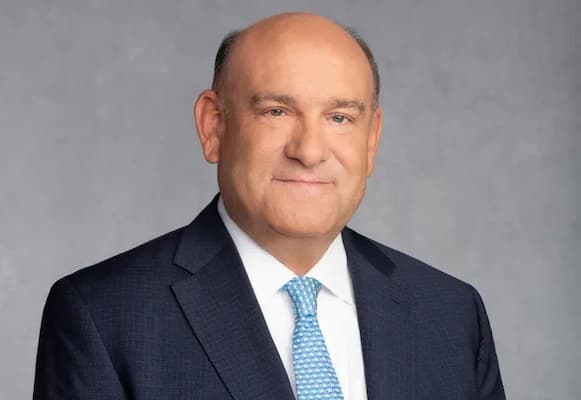
Steve Liesman’s Path From Moscow Bureau Chief to CNBC’s Fed Voice
Long before Steve Liesman became the reporter viewers turn to for real-time analysis of Federal Reserve decisions, he was covering a financial collapse of a different kind entirely — reporting from Moscow during Russia’s 1998 currency crisis. That reporting won him a Pulitzer Prize, and the instincts behind it have anchored his economics coverage at CNBC for more than two decades since.
From Bronxville to Buffalo to Moscow
Steve Liesman was born May 21, 1963, in Bronxville, New York, to Marvin and Bernice “Bunny” Liesman, and attended Edgemont Junior-Senior High School before earning a bachelor’s degree in English from the University at Buffalo. He went on to complete a master’s degree at Columbia University’s Graduate School of Journalism, setting up a career that started not in economics but in general business reporting — first at the Sarasota Herald-Tribune, then the St. Petersburg Times, from 1987 to 1992.
His career took a sharp turn in August 1992, when he relocated to Russia to become the founding business editor of The Moscow Times, the country’s first English-language daily newspaper. While there, he created the Moscow Times Index, Russia’s first stock index — a genuinely foundational contribution to the country’s then-nascent financial press.
A Pulitzer for Covering Russia’s Collapse
Liesman joined The Wall Street Journal in 1994, and was named the paper’s Moscow bureau chief in 1996. It was there that he led part of the Journal’s reporting team recognized with the 1999 Pulitzer Prize in international reporting for its coverage of the 1998 Russian financial crisis. That recognition wasn’t without controversy: journalists Matt Taibbi and Mark Ames later criticized the Pulitzer-winning coverage in The Nation, arguing that Liesman’s sourcing — including reliance on controversial privatization architect Anatoly Chubais and other figures tied to Russia’s reform push — had contributed to an overly optimistic economic outlook in the run-up to the crash. Liesman also received the first runner-up award in the 1998 SAIS-Novartis Prize for International Reporting for a separate four-part series, “Markets Under Siege.”
He later moved to the Journal’s New York bureau, covering the international oil and gas industry, before joining CNBC in April 2002.
Becoming CNBC’s Face of the Fed
At CNBC, Liesman has spent more than two decades as senior economics reporter, covering the Federal Reserve, major economic indicators, and the broader U.S. and global economy, with regular appearances on “Squawk Box” and other programming throughout the business day. He’s become closely associated with a specific visual habit — walking through economic data live on air using a paper “easel,” a low-tech signature in an industry increasingly built around digital graphics. His coverage during the 2008 financial crisis earned him an Emmy Award, adding to the Pulitzer he’d already won for his Russia reporting.
The role hasn’t been without physical risk. In 2007, while reporting on the financial crisis for CNBC, Liesman was struck in the eye when a demonstrator threw a piece of paper at him during a broadcast — a reminder that his beat, even from a news desk, has occasionally put him in the middle of real public tension around economic policy.
Liesman’s coverage has remained squarely current: as of mid-2026, he’s been reporting extensively on new Federal Reserve Chairman Kevin Warsh, including breaking down Warsh’s preference for a more opaque Fed communication style and his repeated framing that “inflation is a choice” — coverage that places Liesman at the center of one of the most closely watched leadership transitions in recent Fed history.
Personal Life: Family and a Grateful Dead Cover Band
Liesman has been married to author Karen Fran Dukess since 1991; the two wed in a ceremony officiated by Rabbi Jon R. Haddon at the Manursing Island Club in Rye, New York. Dukess holds a degree in Russian studies from Brown University and a master’s in journalism from Columbia, and is the author of the novels “The Last Book Party” and “Welcome to Murder Week.” The couple have two sons, whose names they’ve kept out of public reporting.
Outside journalism, Liesman is an amateur guitarist who plays rhythm guitar in Stella Blue’s Band, a Grateful Dead cover act founded in 2009 that was the first band chosen for a residency at Garcia’s at the Capitol Theater in Port Chester, New York, and later played a headline slot at the 50th Woodstock Anniversary event at Yasgur’s Farm. He also hosted the pay-per-view broadcast of the Grateful Dead’s “Fare Thee Well” reunion concerts in Chicago in July 2015.
It’s worth noting that a handful of lower-quality bio sites have circulated entirely incorrect personal details about Liesman — including a fabricated wife named “Cindy” and children named “Matthew” and “Meredith” — which directly contradict his well-documented marriage to Karen Fran Dukess and don’t match any credible source.
Quick Facts
| Category | Detail |
|---|---|
| Full name | Steve Liesman |
| Born | May 21, 1963, Bronxville, New York |
| Occupation | Senior Economics Reporter, CNBC |
| Education | B.A. English, University at Buffalo; M.S. Journalism, Columbia University |
| Prior outlets | The Moscow Times (founding business editor), The Wall Street Journal (Moscow bureau chief) |
| Major awards | Pulitzer Prize, International Reporting (1999, WSJ team); Emmy Award (financial crisis coverage) |
| Joined CNBC | April 2002 |
| Signature habit | Explaining economic data live using a paper “easel” |
| Spouse | Karen Fran Dukess (m. 1991), novelist |
| Children | Two sons |
| Music | Rhythm guitarist, Stella Blue’s Band (Grateful Dead cover band) |
FAQ
What is Steve Liesman known for at CNBC? He’s CNBC’s senior economics reporter, covering the Federal Reserve and major economic indicators, best known for his live, easel-based breakdowns of economic data on programs like “Squawk Box.”
Did Steve Liesman win a Pulitzer Prize? Yes. He was part of The Wall Street Journal’s reporting team awarded the 1999 Pulitzer Prize in International Reporting for coverage of the 1998 Russian financial crisis.
Was Steve Liesman injured on the job? Yes. In 2007, he was struck in the eye by a piece of paper thrown by a demonstrator while reporting on the financial crisis for CNBC.
Who is Steve Liesman’s wife? Author Karen Fran Dukess, whom he married in 1991. She’s written the novels “The Last Book Party” and “Welcome to Murder Week.”
Does Steve Liesman have other interests outside journalism? Yes — he’s an amateur guitarist who plays in Stella Blue’s Band, a Grateful Dead cover band, and has performed at events including the band’s 50th Woodstock Anniversary show.
A Career Built on Following the Data
Steve Liesman’s path from a small-market business reporter to CNBC’s most recognizable economics voice runs through some of the most consequential financial stories of the past three decades — Russia’s currency collapse, the 2008 crisis, and now the leadership transition at the Federal Reserve itself. Through all of it, the throughline has stayed the same: a reporter who’d rather walk viewers through the actual numbers, paper easel and all, than lead with the noise around them.