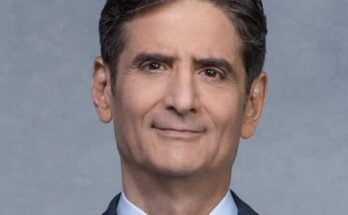
Michael Barbaro: The Journalist Who Turned a Podcast Into a National Habit
Michael Barbaro has become one of the most recognizable voices in American journalism without ever appearing on television. As the host of “The Daily,” The New York Times’ flagship podcast, he built a daily audio habit for millions of listeners—a format almost nobody expected would become one of the most influential news products in the country.
Early Life and Education
Michael Christopher Barbaro was born on October 12, 1979, in New Haven, Connecticut, and grew up in nearby North Haven. His parents worked outside the media industry entirely: his father, Frank, worked as a firefighter in Connecticut, while his mother, Jean, worked as a library media specialist at Anna Reynolds Elementary School in Newington, Connecticut — a household that gave him no direct family pipeline into journalism, unlike many of his peers in the field.
Barbaro attended Hamden Hall Country Day School before enrolling at Yale University, where his interest in journalism took shape early — he reported for the Yale Daily News and eventually rose to editor-in-chief, overseeing a staff of nearly 100 student writers. He graduated from Yale in 2002 with a bachelor’s degree in history.
Starting Out at The Washington Post
Barbaro’s first job out of college was at The Washington Post, where he worked as a reporter covering the biotechnology industry — a technical, unglamorous beat that’s a world away from the political journalism he’d later become known for, but one that gave him a solid grounding in careful, source-driven reporting.
Joining The New York Times
In 2005, Barbaro moved to The New York Times. His early years there were spent on the business desk, where he covered Walmart extensively through 2007. From there, he shifted to City Hall reporting in New York City and then to covering the American retail industry, building a broad base of reporting experience across business, local government, and consumer trends before eventually moving into politics.
Becoming a National Political Reporter
Barbaro became a national political correspondent for the Times, and his profile rose sharply during the 2016 presidential election. He was among the paper’s most prominent reporters covering Donald Trump’s campaign, writing front-page investigative stories — including reporting on Trump’s conduct toward women that drew a direct public response from Trump himself. During the campaign, Barbaro also hosted “The Run-Up,” a Times political podcast chronicling the 2016 race, which would end up serving as the direct forerunner to his next, far bigger project.
The Creation of “The Daily”
“The Daily” launched in January 2017, created by Lisa Tobin and Theo Balcomb as an outgrowth of “The Run-Up,” with Barbaro brought on as host. The premise was simple: a 20-to-30-minute weekday podcast built around a single story from that day’s Times reporting, usually featuring an interview with the Times journalist who broke it. By Barbaro’s own account, he wasn’t even a regular podcast listener before taking the job — his last piece of magazine writing had run just weeks before “The Daily” launched.
The show’s growth was fast and, at the time, unprecedented for news audio. Within its first year, it became the most-downloaded new show on Apple Podcasts, drawing more than a million listeners a day and eventually growing to an audience of several million, with reporting at the time crediting the podcast with meaningfully boosting the Times’ subscription revenue. It won a duPont-Columbia University Award for audio excellence in 2018, with Columbia’s journalism school calling it one of the signature achievements in podcasting that year and crediting it with inspiring a wave of imitators across the industry. The show was named a top podcast of the year by outlets including Time, Entertainment Weekly, The Atlantic, Esquire, Adweek, The New Yorker, and New York Magazine. Barbaro has since been described as a defining figure in the rise of narrative news podcasting, drawing comparisons to public radio storytellers like Ira Glass for his ability to bring a human angle to the day’s headlines. “The Daily” now shares hosting duties among Barbaro and Times colleagues Rachel Abrams and Natalie Kitroeff.
Adjusting to Sudden Fame
Barbaro’s rise from behind-the-byline reporter to a recognizable public figure happened quickly, and by his own account it took some adjustment. He’s described losing his anonymity almost overnight once the show took off — an experience he’s illustrated with a small, telling anecdote: driving a U-Haul through New York City, he found himself waving pedestrians across the street, half-charmed and half-unsettled that strangers now recognized him. Profiles from this period, including a widely discussed piece in Vanity Fair, dubbed him “the Ira Glass of the New York Times” and took particular note of his personal style — his glasses, beard, and pattern-mixing wardrobe becoming almost as much a subject of press coverage as his journalism itself.
Public Speaking and Media Presence
Beyond the podcast itself, Barbaro has become a sought-after public speaker, appearing at universities and public events, including a sold-out talk at New York’s 92nd Street Y, to discuss the state of journalism, the rise of podcast audio versus cable news, and how “The Daily” approaches breaking down complex stories for a broad audience. He’s also made television appearances, including on “Late Night with Seth Meyers,” extending his public profile beyond audio.
Personal Life
Barbaro’s personal life shifted significantly during the same period his professional profile was rising. In October 2014, he married Timothy Levin, a fellow Yale graduate roughly eight years his senior, in a ceremony held at their New York apartment. Levin is the founder of Bespoke Education, a tutoring and test-preparation company, and holds a master’s degree in education from Columbia University. The marriage ended in divorce, reported in July 2018; Barbaro later spoke publicly about the breakup happening not long after “The Daily” launched, noting in a 2019 interview with the Evening Standard how disorienting it was to have his personal life shifting at the same moment his career was taking off.
Barbaro went on to marry Lisa Tobin — one of the co-creators and the executive producer of “The Daily” — in 2020. The two had previously purchased an apartment together in Brooklyn. The couple has two children together. Tobin continues to work at the Times as an editor overseeing its audio division, meaning Barbaro’s professional and personal life have remained closely intertwined at the paper for years.
Quick Facts
| Category | Detail |
|---|---|
| Full name | Michael Christopher Barbaro |
| Born | October 12, 1979, New Haven, Connecticut |
| Education | Yale University (BA, History, 2002) |
| Known for | Host of “The Daily,” The New York Times |
| Years active | 2002–present |
| Spouse | Lisa Tobin (m. 2020); previously married to Timothy Levin (m. 2014; div. 2018) |
| Children | 2 |
FAQ
What is Michael Barbaro known for?
He’s best known as the host of “The Daily,” The New York Times’ daily news podcast, which he has hosted since its 2017 launch.
Where did Michael Barbaro go to college?
He attended Yale University, graduating in 2002 with a bachelor’s degree in history, and served as editor-in-chief of the Yale Daily News while there.
Did Michael Barbaro work anywhere before The New York Times?
Yes — he started his career at The Washington Post in 2002, covering the biotechnology industry, before joining the Times in 2005.
Is Michael Barbaro married?
He married Lisa Tobin, a co-creator and executive producer of “The Daily,” in 2020. He was previously married to Timothy Levin from 2014 to 2018.
Why Barbaro’s Career Matters
Michael Barbaro’s trajectory — from a biotech beat reporter to City Hall correspondent to the voice millions of Americans hear every weekday morning — tracks the broader transformation of news consumption over the past two decades. He didn’t just adapt to the shift toward audio and on-demand media; as the host of “The Daily,” he helped define what that shift would sound like, all while navigating a very public personal transformation alongside his professional one.