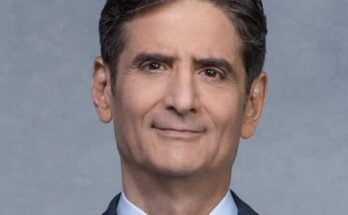
Carl Quintanilla’s Long Run From a Ponzi Scheme Softball to Squawk
Carl Quintanilla has anchored CNBC’s flagship morning coverage from the floor of the New York Stock Exchange for well over a decade, but his career has also included two genuinely uncomfortable, well-documented moments of public criticism — one from Jon Stewart, one from a presidential debate stage — that have shaped how some viewers see him alongside the financial journalism he’s best known for.
From a Boulder Newspaper to the Wall Street Journal
Carl Quintanilla was born September 10, 1970, in Midland, Michigan. As a kid, he wanted to be a disc jockey, and as a high schooler, he interned at Denver’s alternative Westword Magazine—an early sign of media interest that predated his eventual finance beat entirely. He attended the University of Colorado Boulder, earning a Bachelor of Arts in political science in 1993, and worked as a reporter and columnist for Boulder’s Daily Camera from 1991 to 1993 while still a student, along with a summer stint as an editorial assistant for NPR in Washington, D.C.
From 1994 to 1999, Quintanilla worked as a staff reporter for The Wall Street Journal’s Chicago bureau, covering airlines, manufacturing, and broader economic issues and writing a weekly front-page column on workplace trends. That six-year run at the Journal gave him the financial reporting foundation that would define the rest of his career.
Building a Career at CNBC and NBC
Quintanilla joined NBCUniversal in 1999, initially serving as a correspondent for CNBC’s Business Center and as a special correspondent for Fox X-press on Fox News, before co-anchoring CNBC’s early-morning program “Wake Up Call.” Starting December 19, 2005, he co-anchored “Squawk Box,” and that same year, as part of NBC’s team coverage of Hurricane Katrina, he shared in a haul of major journalism honors: a national Emmy, a DuPont Award, an RTNDA Edward R. Murrow Award, and broadcasting’s highest honor, the Peabody Award.
In July 2011, Quintanilla left “Squawk Box” to help launch “Squawk on the Street,” broadcasting live from Post 9 at the New York Stock Exchange — the role that’s defined the bulk of his career since. He later added “Squawk Alley” (2014) and, more recently, “TechCheck,” to his anchoring duties. Beyond CNBC’s core programming, Quintanilla has also been a New York- and Chicago-based correspondent for NBC’s “Today” and “NBC Nightly News,” substitute-anchoring the latter’s weekday and weekend editions from 2010 until September 2015 whenever Brian Williams or Lester Holt were away, and he’s continued as Sunday anchor of both “Weekend Today” and the Sunday edition of “NBC Nightly News.” His reporting has also taken him to five Olympic Games, the 2004 U.S. presidential campaign, and international conflict zones from Israel to Iraq, along with a stretch of one-hour CNBC documentaries covering subjects like Costco, BMW, McDonald’s, and the garbage industry.
Two Moments of Real Public Criticism
Quintanilla’s long tenure hasn’t been without genuine controversy. In the aftermath of the 2008 financial crisis, Jon Stewart publicly criticized Quintanilla and other CNBC personalities on “The Daily Show” for failing to anticipate the downturn or press Wall Street executives with tougher questions — a moment that became emblematic of broader criticism of financial media’s pre-crisis coverage. That criticism took on added weight in hindsight: Quintanilla had once asked Allen Stanford, later revealed as the mastermind behind a massive Ponzi scheme, what it felt like to be a billionaire — a clip that resurfaced repeatedly once Stanford’s fraud came to light.
A second, more direct controversy came on October 28, 2015, when Quintanilla moderated the third Republican Party presidential primary debate for CNBC, held at his alma mater, the University of Colorado Boulder. He and his co-moderators faced heavy, widely reported criticism afterward for appearing ill-prepared and, according to several outlets, rude toward the candidates on stage — a rare instance of a financial news anchor becoming the story himself rather than reporting on it.
Personal Life
Quintanilla is married to Judy Chung, a former television producer who now works as a product manager for Ralph Lauren. The couple and their family live in Bridgehampton, New York, where they purchased a seven-bedroom home in 2017.
Quick Facts
| Category | Detail |
|---|---|
| Full name | Carl Quintanilla |
| Born | September 10, 1970, Midland, Michigan |
| Occupation | Co-anchor, “Squawk on the Street” and “TechCheck,” CNBC |
| Education | B.A., Political Science, University of Colorado Boulder (1993) |
| Prior outlet | The Wall Street Journal, Chicago bureau (1994–1999) |
| Joined NBCUniversal | 1999 |
| Major awards | Emmy Award, Peabody Award, Edward R. Murrow Award, DuPont Award (Hurricane Katrina coverage, 2005) |
| Notable controversy | Co-moderated the criticized October 2015 CNBC Republican presidential debate |
| Spouse | Judy Chung |
| Residence | Bridgehampton, New York |
FAQ
What show does Carl Quintanilla anchor? He’s co-anchor of CNBC’s “Squawk on the Street,” broadcasting live from the New York Stock Exchange, along with “TechCheck.”
Did Carl Quintanilla work at The Wall Street Journal? Yes. He was a staff reporter in the paper’s Chicago bureau from 1994 to 1999, covering airlines, manufacturing, and economic issues before joining NBCUniversal.
Why was Carl Quintanilla criticized over the 2015 Republican debate? He and his fellow CNBC moderators faced widespread criticism for appearing unprepared and, according to multiple reports, rude toward the candidates during the October 2015 GOP primary debate at the University of Colorado Boulder.
Did Carl Quintanilla interview Allen Stanford? Yes. He once asked Stanford, later exposed as the architect of a massive Ponzi scheme, what it felt like to be a billionaire — a moment that drew renewed scrutiny after Stanford’s fraud was revealed.
Who is Carl Quintanilla married to? Judy Chung, a former television producer who now works as a product manager for Ralph Lauren.
Two Decades on the Same Beat
Carl Quintanilla’s career maps almost perfectly onto the last two decades of business news itself — a Wall Street Journal reporter who became one of the defining voices covering the market’s worst crisis, its recovery, and everything since from the floor of the exchange itself. That the Jon Stewart criticism and the 2015 debate controversy still follow him is, in its own way, a testament to how closely his career has been watched: few financial anchors have had their own performance scrutinized quite as publicly as the markets they cover.